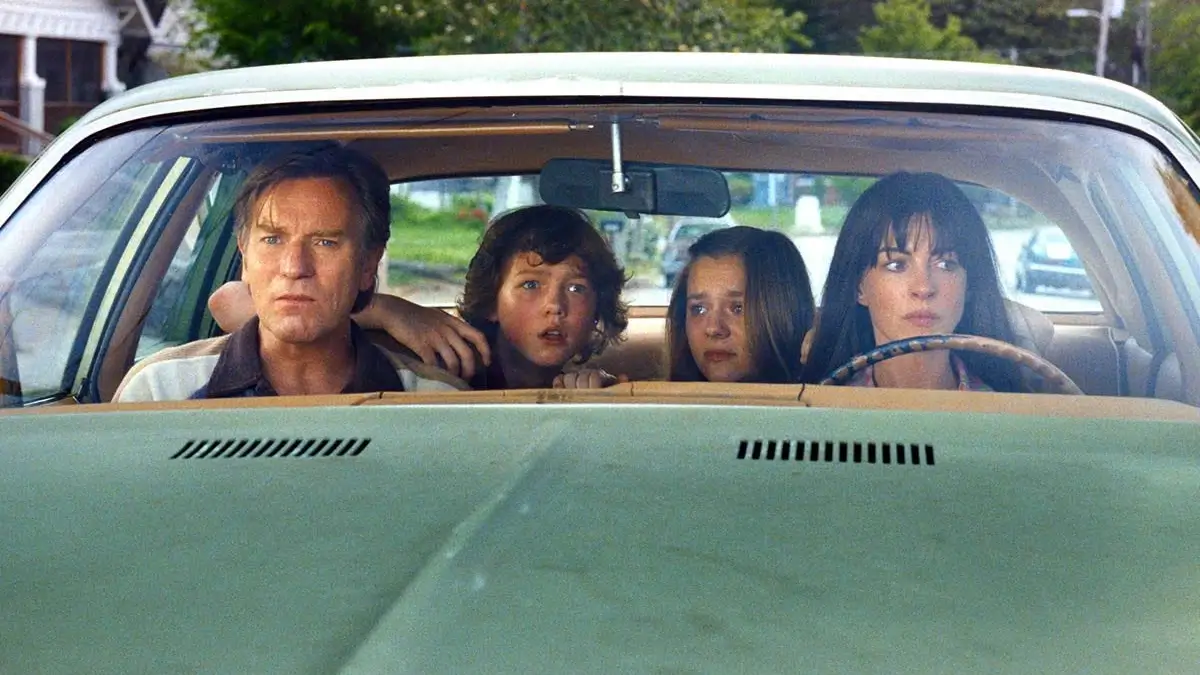

Yes, Greg Platt is alive and grilling burgers at the end of The End of Oak Street, but he is not the same man who survived the prehistoric jungle. David Robert Mitchell’s late-summer sci-fi survival thriller concludes on a sharp, subversive time-loop twist: after watching Greg get torn apart by a Tyrannosaurus rex, Denise, Audrey, Brian, and neighbor girl Jeannette leap through a flickering roof portal and land in an above-ground swimming pool on July 11, 1982—roughly twenty minutes before Oak Street was wiped off the map. By using a roadside payphone to order a pie from Pete’s Pizza straight to an overlook outside the blast zone, Denise successfully lures her husband away from their doomed cul-de-sac right before the anomaly strikes, engineering a sunny suburban reunion that hides an undeniably chilling temporal cost.
Spending time with a creature feature like The End of Oak Street is easy when the first two acts nail the Amblin-style wonder. The pacing is breathless, the dinosaur brutality is surprisingly vicious, and Anne Hathaway’s Denise Platt anchors the chaos with the exhaustion of a mother whose marriage was already disintegrating before the Cretaceous era knocked on her door. But once the survival horror settles, the movie pivots into a time-travel puzzle box that demands a closer look at the timeline mechanics Mitchell leaves beneath the lawn chairs. Here is what actually happened.
How Does the Platt Family Escape the Dinosaurs?
Denise, Audrey, Brian, and Jeannette escape the prehistoric past by leaping through an unstable temporal rift on Mrs. Valcourt’s roof. After Greg is brutally killed by a T-Rex while shielding his family, the surviving Platts and Jeannette realize the spatial distortions that transported their cul-de-sac are shrinking and vanishing fast. They spot a pulsing, spherical anomaly hovering over the second floor of their local librarian Mrs. Valcourt’s home, fight their way past stalking predators with Mrs. Valcourt sacrificing herself to buy them seconds, and scramble onto the rooftop. Timing their jump into the glowing orb alongside their family dog Starbuck, they break through the rift just as the aperture collapses permanently behind them.
Why Did They Land in a Swimming Pool 20 Minutes Early?
The roof wormhole did not drop them forward into the future; it spat them back into July 11, 1982, approximately twenty minutes before the neighborhood vanished. Rather than returning to modern times or to the moment they were taken, the Platts splash into an irritated neighbor’s backyard pool on the same night the disaster began. Because the temporal tear was unstable, it displaced them roughly twenty minutes upstream in time and safely outside the epicenter of the anomaly. This narrow chronological cushion gives Denise and Jeannette a fleeting, one-time opportunity to intervene before the massive white flash consumes Flowervale’s two-mile perimeter all over again.
How Is Greg Still Alive at the End of the Movie?
Greg survives because Denise uses her knowledge of his secret side hustle to pull him outside the anomaly’s destruction radius. Having learned earlier that Greg had lost his corporate job and was secretly delivering pies for Pete’s Pizza, Denise runs to a nearby payphone and places a delivery order directly to a hill outside the borders of Oak Street. Clueless about any dinosaurs or time travel, Greg drives up with the pizza boxes, where he is tearfully ambushed and embraced by his family. Moments later, the entire Platt clan watches from the safety of the hillside as the blinding cosmic flash engulfs Oak Street below, sparing this version of Greg from being transported back into prehistory where his alternate self died.
Why Are There Two Jeannettes at the Barbecue?
The final barbecue features two Jeannettes because the future Jeannette successfully ran down into the neighborhood to evacuate her past self and parents. While Denise made the calculated choice to keep her children safely up on the hill, Jeannette sprinted back into the neighborhood to warn her family before the rift swallowed their house. Jeannette Prime managed to convince her parents and her younger self (Jeannette Two) to get in the car and drive away before the light hit, which allowed both temporal iterations of Jeannette to survive side by side into adulthood alongside their living parents.
Which Neighbors Did Denise Save with Her Phone Calls?
In addition to saving Greg with the pizza order, Denise used her remaining change at the payphone to dial key neighbors and tell them to flee. A closing montage confirms that several people who died gruesome deaths in the prehistoric sequence made it out of the cul-de-sac alive thanks to her anonymous calls. The irascible neighbor Mel Jacobs (played by P.J. Byrne), elderly mentor Mrs. Huddleston (Anne Gee Byrd), and librarian Mrs. Valcourt (Emily Kuroda) all received urgent warnings that prompted them to vacate their properties just before the ground beneath Oak Street was swapped with the Mesozoic jungle.
Did Denise Doom an Alternate Version of Her Own Family?
Yes, the darkest implication of the finale is that Denise abandoned an alternate version of herself and her kids to an even worse fate. Because Denise chose to summon Greg away from their house via payphone instead of running down to evacuate her own home, the original 1982 version of Denise, Audrey, and Brian remained inside when the anomaly triggered. That means an alternate Platt family was sent back into the dinosaur-infested Cretaceous wilderness completely alone—without Greg to help them fight or sacrifice himself—effectively trading their survival so that post-jump Denise could secure a comfortable life with a restored husband.
How Does the Time Travel and Wormhole Logic Actually Work?
The film operates on branching multiverse timeline mechanics rather than a closed-loop causal paradox. If Oak Street followed strict closed-loop physics, saving Greg and preventing his trip to the past would have erased the very journey Denise took to save him, triggering a paradox. Instead, jumping through the fluctuating rift shifted Denise and her kids into a parallel temporal branch where the prior timeline’s deaths still occurred, but a new divergent path was created where select residents escaped the swap, leaving the past version of the cul-de-sac permanently displaced into deep time while the survivors moved forward on an altered branch.
What Happens to Oak Street and the Prehistoric Zone Two Years Later?
Two years after the event, the displaced footprint of Oak Street has become a militarized, fenced-off ecological research zone. The two-mile crater left by the vanished neighborhood remains filled with dense prehistoric jungle, vegetation, and contained wildlife while government scientists attempt to study the residual spatial fluctuations. Denise, meanwhile, capitalizes on the global phenomenon by publishing a bestselling nonfiction memoir appropriately titled The End of Oak Street, transforming their survival nightmare into immense financial security and suburban fame.
Is The End of Oak Street Connected to the Cloverfield Universe?
No, despite intense online theories regarding J.J. Abrams’ Bad Robot producing and the early working title Flowervale Street, the film has no ties to Cloverfield. Speculation ran rampant during production due to the secretive viral marketing, the domestic title change, and the family name resembling characters from earlier Bad Robot releases. However, director David Robert Mitchell designed the story from the ground up as a standalone original sci-fi feature, and Paramount/Bad Robot’s separate anthology franchise has no canonical bearing on the dinosaurs or wormholes seen here.
What Is the Real Symbolic Meaning Behind the Ending?
The ending is a biting, cynical critique of suburban complacency and the moral compromises required to keep an American nuclear family intact. Denise spent the entire first act secretly planning a divorce and writing a novel about a woman escaping domestic suffocation, only to find that surviving an apocalypse led her straight back into the domestic status quo. By trading the harsh truth of Greg’s actual death for an oblivious replacement husband who never earned his redemption through survival, Denise chooses comfortable artifice and financial luxury over emotional reality, proving that suburban denial is even stronger than a prehistoric extinction event.
The End of Oak Street: The Honest Takeaway
What makes The End of Oak Street stick in the teeth long after the credits roll is David Robert Mitchell’s unwillingness to let his Spielbergian homage stay entirely wholesome. The creature set-pieces are loud, physical, and exhilarating, delivering on the promise of dinosaurs turning suburban Michigan into an open buffet, but the final shot refuses to play the happy ending straight. When you look past the sizzling hot dogs, the pristine lawn, and the smiling kids, you realize the Platts bought their picturesque future through calculated abandonment and temporal casualties. That is not just a fun summer blockbuster ending; that is sharp, unapologetic genre filmmaking with real venom behind the nostalgia.
Up next
Keep Reading
The Invite Ending Explained: What Happened Between Joe and Angela, the Piano Scene, and What It Means

Practical Magic Ending Explained: How the Curse Was Broken, Jimmy Banished, and the Canon Status
Everything You Need to Know About the Original Practical Magic, From Where to Stream to How It Sets Up the Sequel