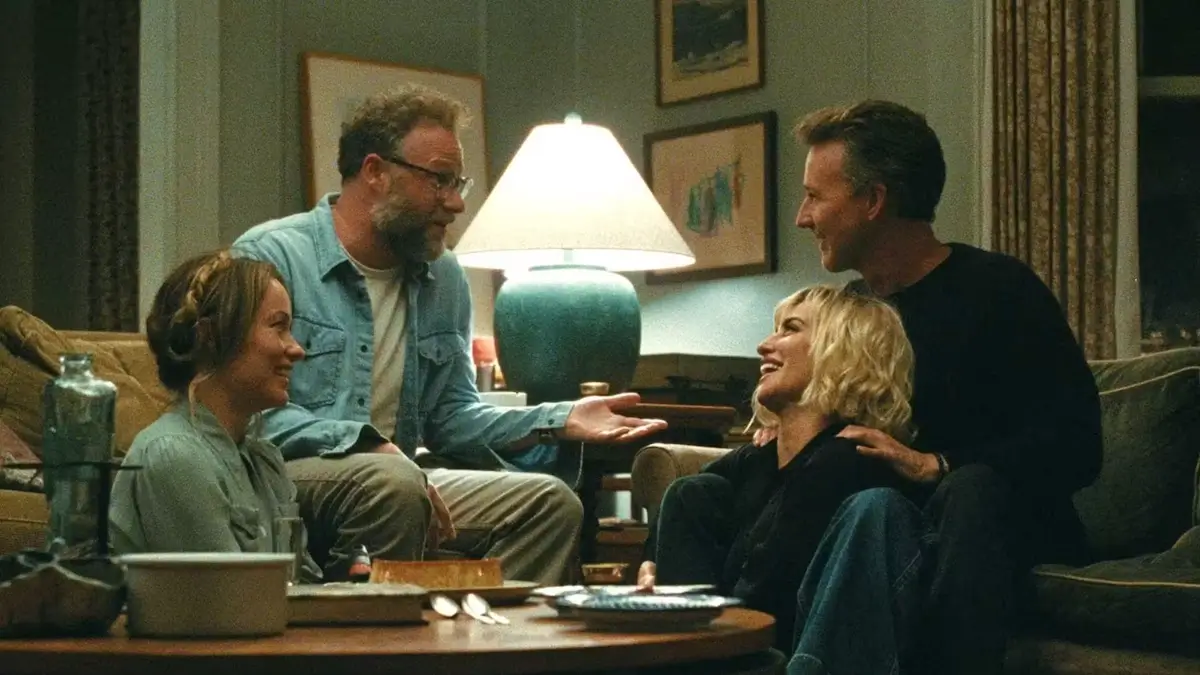

The ending of The Invite does not give Joe and Angela a neat Hollywood reconciliation, nor does it conclude with a bitter courtroom blowout. Instead, Olivia Wilde’s A24 relationship comedy leaves their nineteen-year marriage deliberately unresolved after upstairs neighbors Hawk (Edward Norton) and Piña (Penélope Cruz) leave them to face their ruined dynamic alone. The film closes with Joe (Seth Rogen) playing his long-abandoned upright piano while Angela (Olivia Wilde) silently sits beside him, marking the definitive death of their old marriage and establishing a fragile truce where both finally see each other without the armor of passive aggression.
Sitting through a relationship comedy like The Invite works because the domestic rot feels painfully authentic, the humor cuts bone-deep, and Rogen and Wilde play a couple whose exhaustion carries genuine weight. The film uses an outrageous dinner-party proposition to excavate nearly two decades of buried resentment, turning what looks like an awkward sex farce into a surgical autopsy of adult compromise. Here is how that final scene plays out, what the symbols mean, and where Joe and Angela actually end up.
What Happens at the End of The Invite?
The climax of The Invite strips away every defensive layer of Joe and Angela’s relationship after their neighbors abruptly walk out. When Hawk and Piña realize their hosts are attempting to use an open-ended sexual invitation as a battleground to wage domestic warfare, Piña bluntly diagnoses that Joe and Angela’s connection is already dead, prompting the upstairs couple to make a swift exit. Left in the suffocating quiet of their renovated San Francisco apartment, Joe and Angela unleash years of accumulated rage, broken dreams, and sexual abandonment, finally speaking aloud what they spent years weaponizing through sarcastic jabs. The blowout eventually burns out into raw exhaustion, culminating in Joe sitting down at his neglected piano to play music for the first time in years as Angela quietly joins him on the bench in shared silence.
Do Joe and Angela Break Up or Stay Together?
The film leaves their legal status open-ended, but their marriage as it existed for nearly twenty years is officially over. Director Olivia Wilde avoids the neat closure of a conventional rom-com by refusing to show divorce papers or an overnight romantic rekindling. Instead, the narrative makes it unmistakable that the toxic cycle of silent resentment, passive hostility, and emotional neglect has been permanently broken. Whether they proceed with an amicable separation or attempt to rebuild a completely new dynamic from scratch—honoring Piña’s earlier observation that you can start a brand-new relationship with the same person—the old, bitter version of Joe and Angela did not survive the night.
What Does the Final Piano Scene Really Mean?
The closing piano moment represents honest vulnerability and the surrender of Joe’s long-standing emotional armor. Throughout the film, Joe’s piano sits in the living room as a dusty monument to his abandoned dreams as a musician and his bitter resignation to teaching conservatory students. By physically returning to the keys, Joe stops hiding behind cynicism and lets himself be seen in his purest, most vulnerable state, which Angela recognizes immediately. When Angela sits beside him without uttering a single word, it signals peace rather than romantic passion—a mutual acknowledgment that the war between them is finally over, leaving them in genuine stillness together for the first time in decades.
Why Do Hawk and Pina Leave the Dinner Party?
Hawk and Piña leave because they realize Joe and Angela are emotionally volatile and entirely unsuited for non-monogamy. While the upstairs couple thrives on radical transparency, adventurous sex, and clear boundaries, they quickly recognize that Joe and Angela are attempting to use swinging as a desperate band-aid for an unraveling marriage. Piña, who works as a therapist, spots the emotional toxicity immediately and refuses to let her and Hawk’s dynamic become collateral damage for someone else’s unresolved trauma. They leave not out of disgust or moral judgment, but out of strict self-preservation and healthy boundary-setting, recognizing that their hosts need an intervention, not a four-way.
What Was the Upstairs Sex Offer Actually About?
The proposition of group sex was never about fetishism; it served as a dramatic mirror designed to expose Joe and Angela’s total lack of intimacy. For Hawk and Piña, physical freedom and swinging are natural extensions of a secure, transparent relationship where desires are voiced without fear of judgment. For Joe and Angela, however, the offer operates as an emotional flash grenade that instantly highlights how long they have lived in sexless, resentful coexistence. Angela’s desperate curiosity exposes her profound craving to feel desired and seen, while Joe’s knee-jerk defensiveness reveals his terror of inadequacy and his deep insecurity about the life he built.
Did Joe and Angela Ever Sleep with Their Neighbors?
No, Joe and Angela never go through with the partner swap or group sex. Although plenty of alcohol and nervous curiosity push them into awkward, tentative negotiations—complete with clumsy flirtation and heavy comedic tension—the entire encounter implodes long before anyone takes off their clothes. The theoretical thrill collapses under the crushing weight of their real marital fractures, turning what was supposed to be a sensual experiment into an unbearable interrogation of their own shortcomings. By keeping the sex purely hypothetical, the script ensures that the fallout is entirely emotional rather than a cheap situational gag, forcing the characters to confront their minds rather than their bodies.
What Does Pina’s Diagnosis Reveal About Their Marriage?
Piña’s parting words act as the film’s central thematic verdict: Joe and Angela have weaponized their shared history to avoid being present. As a practicing psychologist, Piña cuts through their polite veneer to point out that they no longer look at each other as human beings, only as repositories for past grievances and disappointed expectations. Her observation exposes that constant bickering has become their only surviving form of intimacy, a dysfunctional substitute for the physical and emotional affection they lost years ago. That diagnosis is the precise catalyst that destroys their defensive posturing, forcing Joe and Angela to recognize that their comfortable mutual misery is slowly poisoning them both.
Is The Invite Based on a True Story or a Remake?
The Invite is not based on a true story; it is an American remake of Cesc Gay’s acclaimed 2020 Spanish comedy Sentimental. Gay originally conceived the story as a hit stage play titled Los vecinos de arriba (The People Upstairs) in Barcelona before adapting it into his award-winning Spanish feature film. Screenwriters Will McCormack and Rashida Jones transposed the chamber-piece premise to modern San Francisco, preserving Gay’s sharp theatrical structure while tailoring the neurotic dialogue specifically to Seth Rogen and Olivia Wilde. The film retains the exact four-person single-apartment setup of the European source material, proving that the awkward agony of middle-aged marital fatigue is universal across cultures.
Where Can You Stream The Invite Right Now?
The Invite is currently available on premium video-on-demand platforms and will stream on Max in late October 2026. Following its Sundance premiere in January and an A24 theatrical run that kicked off in late June 2026, the film hit digital storefronts like Apple TV, Amazon Prime Video, and Fandango at Home for digital purchase and rental in August. A24’s ongoing output deal with Warner Bros. Discovery brings the film to Max on October 23, 2026, where it will be accessible to all active platform subscribers without an additional rental fee. Physical 4K UHD and Blu-ray releases are slated to hit shelves shortly after its SVOD debut.
Does The Invite’s Ending Deliver on Its Premise?
The film’s refusal to deliver a clean, packaged Hollywood resolution is precisely why the ending works so well. A lesser sex comedy would have defaulted to a wacky montage of partner swapping or a tearful rom-com speech in the rain where the couple pledges to fix everything overnight. By keeping the entire third act confined to the raw, quiet aftermath of the blowup, Olivia Wilde and the cast honor the messy truth of real-life marriages, where decades of resentment cannot be erased over dessert. The final image of two exhausted adults sitting at a piano with nothing left to hide behind feels earned, mature, and deeply resonant.
The Invite Ending: The Honest Takeaway
What separates a memorable relationship dramedy from disposable streaming fodder is a willingness to let silence speak, and The Invite understands that silence is where real relationships either survive or suffocate. The movie does not treat infidelity or non-monogamy as an easy punchline; it uses the neighbors’ uninhibited passion as a brutal diagnostic tool for a marriage that died of quiet neglect. Joe and Angela do not walk away with a guaranteed future together, but they walk away with absolute honesty, which is the only thing that could ever save them. If you were looking for an easy happily-ever-after, the movie will frustrate you, but if you value an ending that respects the grueling, complicated reality of long-term commitment, it sticks the landing completely.
Up next
Keep Reading
Everything We Actually Know About The End of Oak Street Ending, From the Pizza Call to the Two Jeannettes
Practical Magic Ending Explained: How the Curse Was Broken, Jimmy Banished, and the Canon Status
Everything You Need to Know About the Original Practical Magic, From Where to Stream to How It Sets Up the Sequel