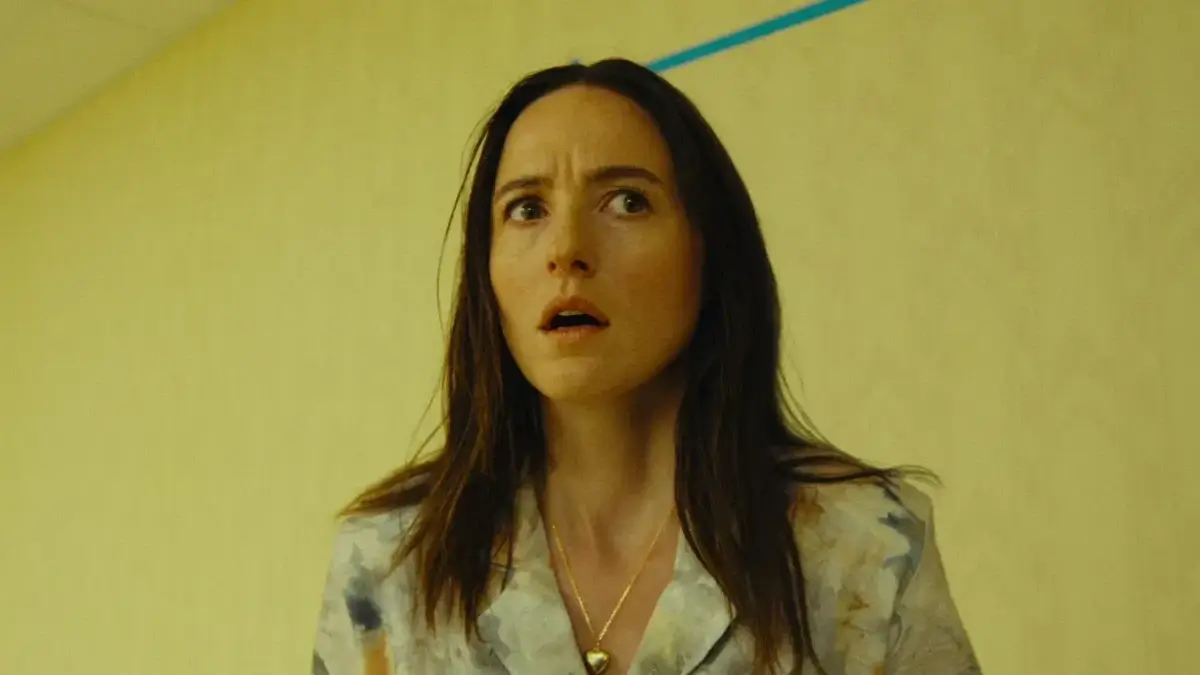

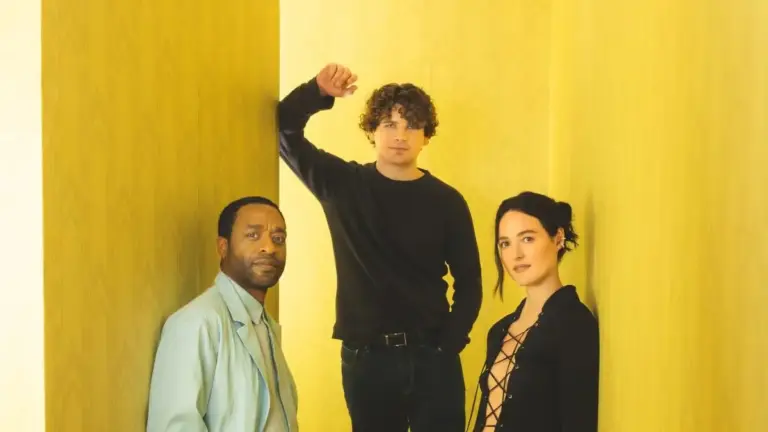
Yes, the ending of The Backrooms delivers a concrete narrative resolution, but it intentionally closes on an unsettling cosmic twist. Kane Parsons’ feature adaptation culminates with the death of furniture store owner Clark (Chiwetel Ejiofor), the extraction of Dr. Mary Kline (Renate Reinsve) by the shadowy Async Research Institute, and a final lingering reveal that reality itself has been irrevocably compromised. While Mary physically survives her descent into the liminal maze, she is neither free nor whole, and the film confirms that Async’s experiments have unlocked thresholds that are beginning to manifest across the globe.
Leaving the theater after The Backrooms feels a lot like waking up from a fever dream that refuses to fade. The dread is institutional, the liminal geometry is suffocating, and Parsons avoids cheap jump scares to deliver something far more insidious about human isolation and memory decay. Rather than tying up the mythology with a neat bow, the finale redefines what the dimension actually does to anyone who crosses its threshold. Here is what that ending actually means.
How Does The Backrooms End?
The climax of The Backrooms ends with Mary escaping the complex’s depths, only to be captured and quarantined by the Async Research Institute. After discovering that Clark has completely succumbed to his delusions and watching him get killed by a monstrous entity wearing his store’s pirate mascot uniform, Mary uses a piece of concrete salvaged from her demolished childhood home to cripple the creature and slip through a narrow dimensional breach. The moment she tumbles through the threshold, hazmat-suited operatives ambush and sedate her with gas. She wakes up inside an austere subterranean facility where an Async lead named Phil interrogates her, confirming that Async has been studying the dimension for years and that similar thresholds are now opening worldwide. When Mary demands to know if she will ever be released, Phil coldly looks away, muttering that the decision is beyond his authority, before the film cuts to a horrifying final shot inside the yellow halls showing a deformed “Still Life” clone of Mary sitting in that exact interrogation chair.
What Happened to Clark in the Furniture Store Basement?
Clark does not survive the Backrooms because his refusal to face his personal failures turns the dimension into a self-inflicted death trap. Having accidentally discovered the spatial anomaly in the basement of his failing furniture store, “Cap’n Clark’s Ottoman Empire,” Clark became obsessively drawn to mapping the infinite halls instead of dealing with his divorce and ruined architectural career, ultimately sacrificing his young employees Bobby and Kat in the process. By the time Mary finds him, Clark has abandoned reality entirely, constructing a makeshift domestic life out of fragmented furniture alongside warped, faceless entities. He dies during their confrontation when Mary forces him to confront his grief and denial, triggering the unstable environment to collapse his psychological defenses and allowing his own manifestation of guilt to consume him.
What Are the Still Lifes and the Captain Clark Monster?
The “Still Lifes” are organic, pseudo-human replicas generated by the Backrooms by recycling the memories, guilt, and emotional baggage of anyone who enters. The terrifying creature stalking the corridors—a towering, disjointed monstrosity wearing the pirate mascot uniform from Clark’s commercial broadcasts—is not an alien demon from another realm, but Clark’s own self-loathing given physical form. Director Kane Parsons frames the dimension as a molecular photocopier that attempts to reconstruct human memories from scratch, producing broken, uncanny imitations when it fails to grasp human emotion. Clark’s monster was essentially his own corporate alter ego turned lethal, hunting him down because he chose to hide inside his manufactured persona rather than endure reality.
Does Mary Actually Escape the Backrooms Alive?
Yes, the physical Mary makes it out alive, but her survival comes at the cost of trading one prison for another. Unlike Clark, who surrendered to the labyrinth’s warped nostalgia, Mary actively fights back against the dimension’s psychological traps by anchoring herself to the harsh truth of her past and using a childhood token to bludgeon the pirate entity. However, stepping through the dimensional threshold does not return her to normal civilian life. Instead, she falls directly into the custody of Async, who clean the blood off her, isolate her in a sterile interrogation room, and view her purely as an asset and research subject with zero intention of letting her walk free.
Who Is Async Research Institute and What Is Their True Goal?
Async Research Institute is the amoral corporate entity responsible for opening the doorway to the Backrooms in an attempt to monetize infinite dimensional space. Expanding directly on the lore of Kane Parsons’ viral web series, the film reveals that Async’s scientists—personified by Mark Duplass’s calculating character, Phil—viewed the dimension as commercial real estate and a breakthrough for human expansion without comprehending its metaphysical hostility. Phil’s interrogation of Mary makes it clear that Async has lost complete control over their project, as portals have begun triggering independently across the planet. Rather than staging a rescue operation for lost civilians, Async’s primary objective is corporate damage control, information containment, and weaponizing whatever knowledge survivors bring out.
What Does the Final Shot of Mary in the Chair Mean?
The final shot reveals that the Backrooms duplicated Mary the exact moment she entered, leaving a hollow copy of her stranded in the yellow halls forever. The movie concludes with a sweeping visual montage traveling backwards through the dimension, showcasing distorted replicas of Mary’s demolished childhood home, her private therapy practice, and the bookstore from her book tour, before settling on an uncanny, multi-eyed Still Life version of Mary sitting frozen in an Async interrogation chair. This establishes the film’s most chilling existential rule: you never truly leave the Backrooms untouched, because the dimension steals your likeness, memories, and identity the second you step inside. Even as the real Mary breathes in captivity under Async’s watch, a piece of her consciousness remains permanently preserved inside the labyrinth’s endless architecture.
Are the Backrooms a Supernatural Realm or a Cosmic Anomaly?
The Backrooms in the film function as an indifferent cosmic afterlife for discarded physical and psychic data rather than a demonic or spiritual plane. As the narrative reveals through Clark’s degraded recordings and Async’s technical readouts, the dimension acts as the universe’s subconscious wastebasket—a place where matter and memory clip out of normal physics and accumulate indefinitely. It does not actively seek to torture victims out of malice; rather, it attempts to organize and mirror whatever conscious data wanders inside. Because human minds are riddled with trauma, grief, and repressed anxiety, the dimension reflects those fractures right back at visitors as horrifying, glitched-out labyrinths and aggressive entities.
Will There Be a Backrooms 2?
A sequel is practically guaranteed given the massive box office success and the explicit franchise setup woven into the ending. With The Backrooms pulling in an unprecedented $81 million domestic opening weekend to become A24’s biggest theatrical launch of all time, both the studio and producers Shawn Levy and James Wan are already developing the next installment. The narrative leaves several massive plot threads dangling: Mary remains trapped inside Async custody, Phil confirmed that breaches are multiplying worldwide, and the presence of Mary’s Still Life clone inside the maze hints that the complex is evolving. Kane Parsons has repeatedly stated that this story was designed to inaugurate a larger cinematic universe exploring Async’s global failure.
Where Can You Watch The Backrooms?
The Backrooms is currently playing across movie theaters and is available on premium video-on-demand platforms like Apple TV and Amazon Prime Video. Following its high-profile theatrical run by A24, the film transitioned to digital rental and purchase windows, with an exclusive streaming destination on Max expected later in the year as part of A24’s ongoing pay-one output deal. Anyone looking to catch up on the foundational lore can also stream Kane Parsons’ original YouTube found-footage shorts for free on the Kane Pixels channel, which establishes Async’s earliest experiments and visual aesthetic.
Why Did The Backrooms Resonate So Deeply With Audiences?
The film broke through because it treated internet folklore with cinematic maturity, prioritizing claustrophobic psychological horror over mindless jump scares. Instead of churning out a generic monster flick, Kane Parsons and writer Will Soodik grounded the iconic yellow-wallpaper aesthetic in genuine human tragedy, anchoring the madness through compelling performances from Chiwetel Ejiofor and Renate Reinsve. The concept of “liminal spaces”—places meant for transition that feel unnatural when frozen in time—resonates deeply with an audience exhausted by modern commercial alienation. By marrying analog VHS dread with themes of grief, divorce, and corporate greed, the film elevated a viral creepypasta into one of the most defining horror entries of the decade.
The Backrooms Ending: The Honest Takeaway
What separates The Backrooms from the endless stream of studio horror junk is that it refuses to give the audience an easy out. Most modern thrillers would have concluded with a triumphant escape or a jump-scare creature pouncing at the lens, but Parsons ends on pure existential rot: an innocent woman trapped in a corporate black site while an uncanny caricature of her sits eternally in a forgotten room. The film never treats the Backrooms as a puzzle to be solved, but as a spatial cancer that human curiosity was foolish enough to spread. A24 took an undeniable gamble handing an eighty-million-dollar studio debut to a twenty-year-old internet director, and the result is an ambitious, disquieting triumph that proves viral horror can transcend memes when backed by real visual discipline and emotional weight.
Up next
Keep Reading
Everything We Actually Know About Backrooms 2, From Kane Parsons’ Return to A24’s Expanded Lore
The Invite Ending Explained: What Happened Between Joe and Angela, the Piano Scene, and What It Means
Everything We Actually Know About The End of Oak Street Ending, From the Pizza Call to the Two Jeannettes